There is a moment most dropshipping stores hit at around the same point. Sales are steady, the product works, and then a customer posts an unboxing video, and the parcel is a grey plastic bag with a Chinese shipping label on it and no indication anywhere that your brand exists.
That is the gap custom packaging closes. This guide covers what is actually available, what each option costs you in effort and money, what minimum quantities are realistic, how long it takes, and which one to add first if you can only do one.
Why it matters more than it looks
Packaging does three specific jobs. It is worth separating them, because different options do different jobs.
It justifies your price. If you sell a harness for £34 and it arrives in an unbranded bag, the customer’s instinct is that they overpaid for something generic. The same harness in a branded mailer with a hang tag reads as a product from a brand, and the price makes sense.
It creates the second purchase. An insert card with a discount code, a care guide or a review request is the only marketing that reaches every single customer at the exact moment they are most positive about you.
It stops you looking like a dropshipper. Not because dropshipping is shameful, but because a customer who works out that your product is a marketplace item with a markup will go and buy it directly next time. This is the step that turns plain dropshipping into branded dropshipping.
One honest caveat. Packaging does not fix a bad product. If the item is poor quality, better packaging just means the customer is more disappointed when they open it. Get the product right first.
The options, cheapest first
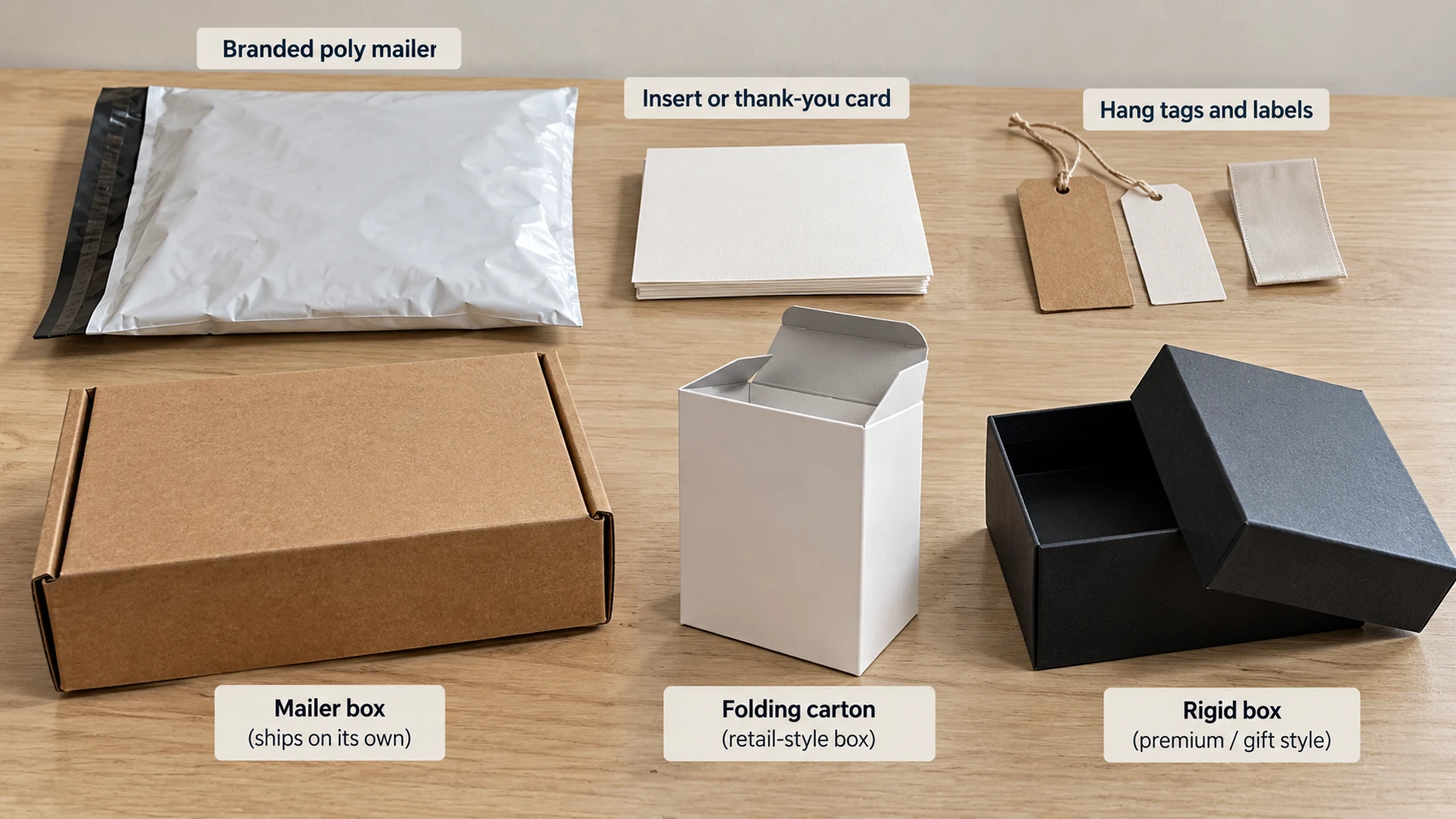
1. Branded poly mailer
Your logo and brand colors printed on the mailer the customer actually receives. For many stores this is the best value first upgrade, because it is the first thing the customer sees and it replaces the generic bag entirely. Whether it is the right starting point for you depends on your product, what it currently ships in, your order volume and what you are trying to change.
- Impact: high, it is the first impression
- Cost: low per unit
- Minimum: small runs are usually possible
- Best for: almost every store, as the first upgrade
2. Insert or thank-you card
A printed card in the parcel. Unlike the other options it can carry an offer, so as well as shaping the impression it can encourage a repeat purchase and give you something measurable through a unique discount code.
What to put on it, roughly in order of usefulness:
-
A discount code for the next order
-
A short care or sizing guide, which reduces returns
-
A polite review request with a direct link
-
Your social handle
-
Impact: high, and partly measurable, because a unique code tells you how often it was used. Redemptions show attributed usage rather than incremental profit, since some of those customers would have ordered again anyway
-
Cost: low per unit
-
Minimum: small runs are usually possible
-
Best for: any store wanting repeat purchases
3. Hang tags and labels
A branded swing tag on the product, or a sewn-in label. This makes the product itself feel like a branded item rather than an unbranded one in a branded bag.
- Impact: medium to high, depending on the product
- Cost: low to medium
- Minimum: small runs usually possible
- Best for: apparel, harnesses, collars, beds and anything textile
4. Logo on the product
Printed, embossed, woven or moulded onto the product itself. This is where you stop reselling someone else’s product and start owning yours.
- Impact: high, and hard for competitors to copy
- Cost: medium, and depends heavily on the material and method
- Minimum: larger than packaging options, because it changes production
- Best for: a proven product you intend to keep selling
5. Printed retail box
A full color printed box. This is the most expensive option and the one most often added too early.
- Impact: high for gifting or premium positioning, low for everything else
- Cost: highest per unit, plus the box adds shipping weight and volume
- Minimum: small runs possible, but the per-unit cost drops sharply with quantity
- Best for: premium products, gift purchases, retail placement
Three things get called “a box”, and they behave differently.
A mailer box is the one with wings that fold over and tuck in, sturdy enough to post on its own without an outer carton. It is usually corrugated, so it protects reasonably well, and it is the common choice for a branded unboxing that also has to survive the courier.
A folding carton is the thin printed card box you see on a shelf, closer to cereal-box material. It prints beautifully and protects very little, so it normally travels inside something else rather than on its own.
A rigid box is the thick, non-collapsing gift-box construction. It feels the most expensive because it is, and it does not ship or store flat as efficiently, which costs you again in transport and space.
Weight is not the only thing you are charged for. Carriers work out a dimensional or volumetric weight from a parcel’s measurements and bill the greater of that and the actual weight. A light product in a large rigid box can therefore cost noticeably more to ship than the same product in a mailer, even though nothing heavier went into it. Work out the delivered cost, not the packaging cost.
Test before you commit to a run. Packaging that looks right on screen can fail in transit. Formal transit-test standards exist for this, and ISTA publishes procedures for it — ISTA 3A covers individual packaged products moving through a parcel delivery system, and ISTA 3L is a more recent generalised e-commerce fulfilment test.
Certification is not required to sell online and most dropshipping stores will never need it. The principle is what matters: get a physical sample, pack it as it would really ship, and send it somewhere real before you order a thousand.
Not every product needs one. A printed box earns its cost when the purchase is a gift, the positioning is premium, or the item is genuinely fragile. For a lot of stores a branded mailer with an insert card achieves more, for less, with less risk.
6. Custom color, material or scent
Changing the product itself so your version is not identical to the one every other store sells.
- Impact: highest, because it makes price comparison impossible
- Cost: varies enormously
- Minimum: production-run territory
- Best for: your single best product, once it is clearly proven
Choosing between them at a glance
The options above are ordered by cost. This is the same six sorted by what you are trying to achieve, which is usually the more useful question.
| Option | Main purpose | Branding impact | Operational complexity | What drives the cost |
|---|---|---|---|---|
| Branded poly mailer | Replace the generic bag | High, immediate | Low, a printed item | Size, material, print area, quantity |
| Insert or thank-you card | Drive the second purchase | Medium, but measurable | Low, a printed item | Card stock, finish, quantity |
| Hang tags and labels | Make the product feel owned | Medium to high | Low to medium, must be attached | Material, attachment method, quantity |
| Logo on the product | Stop reselling, start owning | High, hard to copy | High, changes production | Material, method, production setup |
| Printed retail box | Premium or gift positioning | High in the right context | Medium to high, affects shipping | Construction, print, and shipped volume |
| Custom color, material or scent | Remove direct price comparison | Highest | Highest, a production run | Tooling, materials, run size |
What to add first
If you can only do one thing, the branded mailer is the usual answer. It changes the first impression for a low cost and a small commitment. There are exceptions: if your product already arrives in a decent box, a hang tag or insert may do more, and if you sell something fragile the protective packaging matters before the printed one does.
If you can do two, add the insert card. It can encourage repeat purchases and allows you to track discount-code usage.
A sensible order:
- Branded poly mailer
- Insert card with a discount code
- Hang tag or label
- Logo on the product
- Printed retail box, only if the product is a gift or premium item
- Custom color, material or scent, once one product is clearly proven
Steps four to six are where packaging becomes private label dropshipping, because the factory has to set up for them rather than a print shop.
Realistic minimum quantities
This is where a lot of advice online is misleading, so here is the honest shape of it:
| Option | Realistic minimum |
|---|---|
| Branded poly mailer | Small runs usually possible |
| Insert or thank-you card | Small runs usually possible |
| Hang tags and labels | Small runs usually possible |
| Printed retail box | Small runs possible, but cost per unit drops sharply with volume |
| Logo on the product | Larger, because it changes production |
| Custom mould or material | Largest, because tooling has a real cost |
Two things worth understanding:
A “minimum” is usually about cost, not possibility. A printer can produce 100 boxes. The question is whether the setup cost spread over 100 units makes the per-box price sensible. Often it does not, which is why you will be quoted a larger number.
Packaging minimums are much lower than product minimums. This is the most useful fact in this article. You can look like a proper brand long before you can afford a production run, because mailers, cards and tags are printed items rather than manufactured products.
How long packaging takes
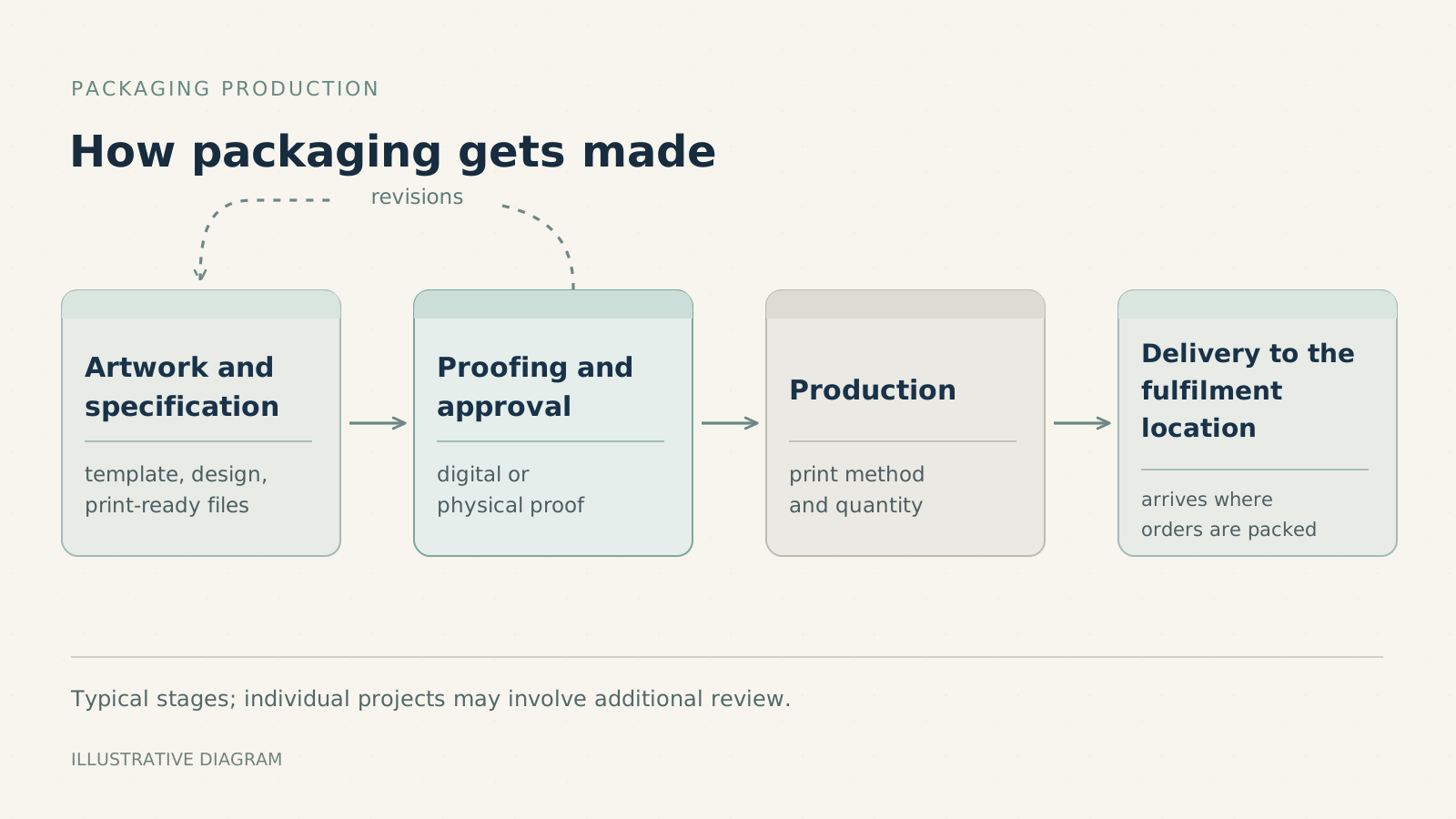
Packaging is not instant, and the delay is rarely the printing itself. These are the stages that actually consume the time, roughly in order.
Artwork and specification. Getting the print template from whoever is producing the item, designing to it, and getting colour modes, bleed and safe margins right. This stage is entirely within your control and is the one most often underestimated. Briefing a designer before you have the template usually means doing it twice.
Proofing and approval. A digital proof is quick. A physical proof, where you see and handle the printed item before committing, adds a round trip and prevents the expensive category of mistake. Whether you need one depends on how much is riding on the run.
Production. This varies most. Digital printing on mailers and cards is generally quicker than offset, and anything requiring a new die or mould sits in a different category again, because tooling has to be made before anything is printed. Quantity matters too, though not proportionally: once a press is set up, a larger run does not usually take proportionally longer.
Arrival where it is needed. Packaging is no use until it reaches whoever packs your orders, so it carries its own transit time on top of production.
Complexity drives all four stages more than quantity does. A one-colour mailer in a standard size is a short path. A custom-die rigid box with a foil finish is a long one, and the tooling has to exist before anything can be printed at all.
What this means in practice: start the packaging conversation while a product is still proving itself, not after it takes off. The stores that get caught out are the ones that wait for a product to succeed and then find branding cannot be applied to the orders already queued.
What it costs, honestly
We are not going to print a price list here, because packaging pricing depends on size, material, print method, finish and quantity, and any number published on a website would be wrong within months.
What we can tell you about the shape of it:
- Mailers, cards and hang tags typically add a small amount per unit, usually a minor cost relative to the product
- Printed retail boxes cost significantly more, both to produce and to ship, because they add weight and volume
- Product-level branding varies most of all, depending on material and method
- Every option gets cheaper per unit as quantity rises, and setup costs are the main reason
When you ask a supplier for a packaging quote, ask for it separately from the product cost. If it is bundled into one number you cannot see what the branding is actually costing you per unit, and you cannot work out whether it is worth it.
Practical mistakes to avoid
Ordering packaging before the product is proven. Buying a thousand printed boxes for a product that stops selling in six weeks is the most common expensive mistake in this whole area.
Designing for print without checking the spec. Print areas, safe margins, color modes and file formats all matter. Get the template from your supplier before you brief a designer, not after.
Forgetting the size range. If you sell one product in five sizes, your mailer needs to fit the largest one without swamping the smallest.
Ignoring shipping weight. A rigid printed box can meaningfully change your shipping cost per order. Work out the delivered cost, not the packaging cost.
Putting a discount code on an insert with no expiry. You will be honouring it in three years.
Making the insert card about you. “Thanks for supporting our small business” is fine, but a care guide, a sizing tip or an actual discount does more work.
What to send us for an accurate quote
Packaging quotes are slow and vague when the request is vague. These are the things that actually change the answer.
The four that get you a real answer:
- Estimated order quantity and monthly order volume. This moves per-unit cost more than anything else on the list, because setup is spread across the run. An honest estimate is more useful than a hopeful one.
- What the product is, with its dimensions and packed weight. A mailer that fits a phone case does not fit a hoodie.
- Which options you are considering — mailer, insert card, hang tag, label, printed box, or a combination. “I do not know, what fits?” is a perfectly normal answer.
- Where orders ship to. A printed box that is economic to one market may not be to another, because it adds weight and volume.
The four that make it accurate:
- The full size range. If one product ships in five sizes, say so. It usually means one mailer size or two, not five.
- Artwork status — a print-ready file, a logo only, or nothing yet. Nothing yet is normal, and changes the timeline rather than the possibility.
- Any packaging dimensions you already have to match, for instance if it must fit an existing insert or outer carton.
- Any deadline — a launch, a seasonal window, or none.
You do not need all eight to start. The first four get a useful answer; the rest make it precise.
A sensible starting point
For most stores at the point where this starts mattering:
- One branded poly mailer design that fits your main product range
- One insert card with a discount code for the next order
- Hang tags, if your products are textile
That combination changes the unboxing experience completely, is achievable in small quantities, and does not require you to commit to a production run of anything.
Then wait. Let a product prove itself over a few months before you put money into product-level branding or printed boxes.
What we do, specifically
Everything above is true whoever you use. This part is about us.
Axono Shipping is one business covering product sourcing and procurement, supplier communication, agreed quality checks, custom branding and packaging, inventory handling, dropshipping order fulfilment and international shipping. Packaging is not a separate service bolted on: the same company that arranges your mailers, insert cards, hang tags, labels and printed boxes is the one packing and shipping your orders, which is why the two can be coordinated at all.
You can use the whole chain or one part of it. Some sellers come to us for sourcing alone. Others already have a supplier and want the branding and fulfilment side.
One distinction worth being clear about, because it is easy to conflate. Fulfilling individual orders and manufacturing custom-branded packaging are different activities with different minimums. Printers and factories set their own minimum quantities for producing branded materials, and those apply regardless of how your order fulfilment is arranged.
Want your packaging quoted separately and honestly? Tell us what you want branded and we will quote the packaging as its own line, so you can see exactly what it adds per unit. If you also want the orders picked, packed and shipped, that is dropshipping fulfillment and we handle both together.